
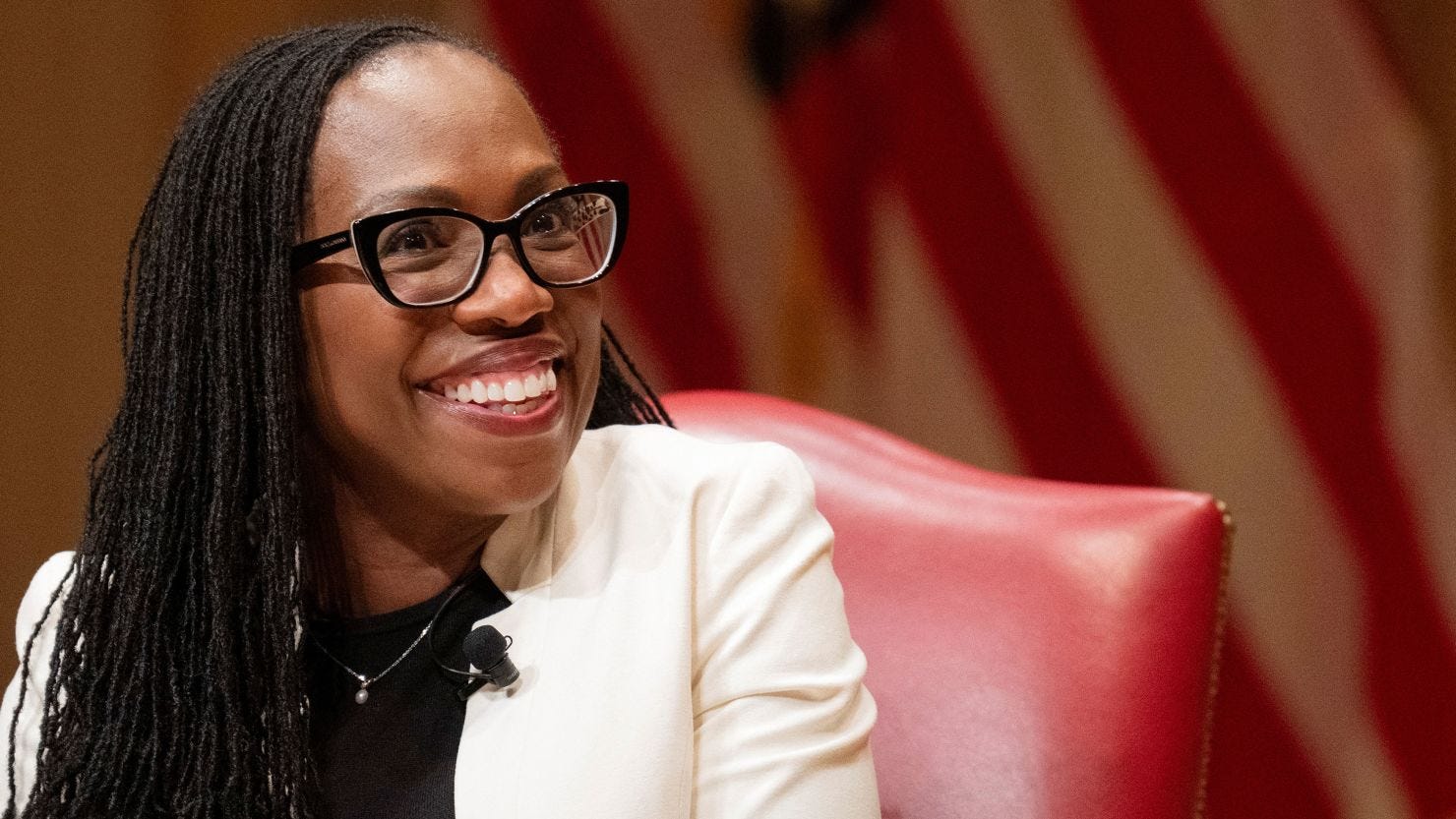
I Can’t Believe Justice Jackson Had the Nerve To Say This
Ketanji Brown Jackson wants you to believe she’s the most impartial justice on the Supreme Court. Cute story, isn’t it? The fact is, her own opinions, her own colleagues, and her own conduct on the bench beg to differ.
Since joining the Court as Joe Biden’s DEI pick, Jackson has built a reputation for something other than legal rigor. Her dissents read less like judicial opinions and more like social media replies, packed with snarky, playground-level digs and thin on actual legal reasoning. Fellow justices, including liberal ones, have called her out for it. When you can’t get your own ideological allies to sign onto your dissent, that tells you something.
And that’s been happening a lot. Jackson frequently finds herself the lone dissenter in cases that should have been unanimous. Listen to her during oral arguments and you’ll often catch her admitting she doesn’t fully grasp the issue in front of her, which isn’t exactly a confidence booster from a sitting justice.
Take her performance during oral arguments in Louisiana v. Callais, the case on racial gerrymandering.
Jackson bizarrely argued that any state that doesn’t draw districts based on race is engaging in straight-up discrimination. How did she reach that conclusion? Well, she equated black voters to disabled Americans who lacked wheelchair ramps before the Americans with Disabilities Act.
Jackson also objected to the Court immediately putting its ruling into effect (because, obviously it would hurt Democrats in the midterms) calling the decision “unwarranted and unwise” and accusing the majority of “unshackling” itself from procedural constraints. Justice Samuel Alito wasn’t having it. He pointed out that Jackson’s approach would have kept Louisiana stuck using a map the Court had already found unconstitutional, and noted that not a single colleague joined her solo dissent. Alito flipped her own rhetoric back on her, concluding it was Jackson’s dissent, not the Court’s order, that lacked restraint and discipline. Her dissent was so partisan, so poorly reasoned that neither of the Court’s other liberals, Justices Kagan and Sotomayor, joined onto it.
In Trump v. CASA, Inc., Justice Amy Coney Barrett’s majority opinion took Jackson apart piece by piece, writing that her dissent is “tethered neither” to legal doctrine, text, or history, and accusing it of demanding an “imperial Judiciary” that overrides constitutional limits on judicial power. Barrett noted that Jackson’s theory would force the executive branch to obey the reasoning of any court in the country, contradicting “more than two centuries’ worth of precedent” and the Constitution itself.
So naturally, with that record trailing behind her, Jackson decided the perfect venue to talk about judicial impartiality was Michelle Obama’s IMO podcast.
Asked how she navigates public appearances, Jackson told Obama she has invitations “screened by the legal office, the public information office, just to make sure that there are no ethical conflicts, that this is not a fundraiser.” She said she tries “to be very, very mindful and scrupulous with respect to that because... our obligation is to be unbiased in our approach,” adding, “you have to then navigate all the sources that could make for an appearance of partiality, which you want to avoid. So there are lots of things that I end up not accepting for that reason.”
Imagine having the nerve to say that on a podcast co-hosted by Michelle Obama and expecting anyone to keep a straight face. Legal reasoning clearly isn’t Jackson’s strong suit, and judging by her comments on the podcast, neither is self-awareness.


