


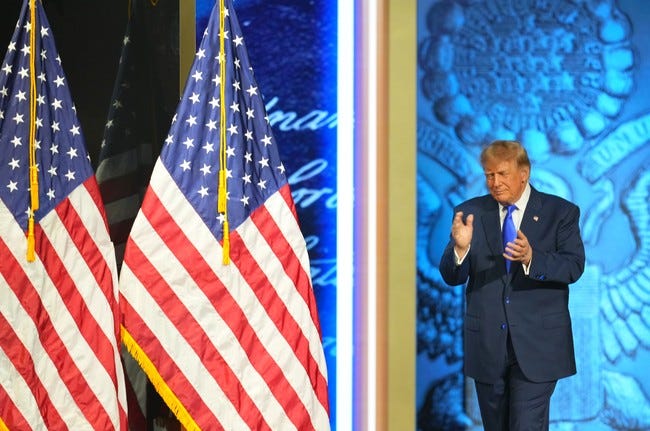
On the first night of the Republican Party’s midterm convention in Dallas, there was something that had absolutely no connection with the message the GOP leaders wished to get across to voters. The promise that President Donald Trump made was so huge, so costly, and so surprising that even the most senior Republican member of the Senate found out about it just as you did. So did the conservative think tanks and most of the party. What on earth was he thinking?
On Wednesday, at the Republican Party’s midterm convention in Dallas, Trump made the proposal: a $5,000 “dividend” for every adult citizen, provided that the Republicans win control of both the House and the Senate after the midterm elections. The nonpartisan Committee for a Responsible Federal Budget has estimated the cost at about $1.2 trillion for one year, a whopping 3.5% of the whole American economy.
But something else about this proposal is concerning.
As the Washington Sun reported, the White House neither briefed nor consulted Senate Majority Leader John Thune (R-S.D.) beforehand. It also left out several major conservative think tanks and advocacy groups. A person who had been briefed on the plan stated that the preparation thereof was “not very vigorous.”
I’m sorry, but that’s not how you roll out a $1.2 trillion policy.
Douglas Holtz-Eakin, president of the American Action Forum and a former Congressional Budget Office director, didn’t hold back, either. “Of course they didn’t know. No one knew it was coming. The Republicans on the Hill I talk to were not kept in the loop on this,” he said. “It’s a bad idea. There’s no need for it economically, and it looks desperate politically.”
Nevertheless, some Republicans do support this proposal.
Sen. Bernie Moreno (R-Ohio) said that he “will get a bill so that the Trump Dividend passed immediately after the November 3rd election.” Vice President JD Vance described it as a “dividend for American workers” that would let Americans “share in some of the benefit of this incredible wealth that we’re creating in the United States.”
But most aren’t convinced.
A senior aide to the Senate Republicans stated outright that “it’s not going to happen,” referring to inflation, which many people still attribute to the pandemic-era stimulus payments that the Biden administration issued. Conservatives have for years criticized Joe Biden for trying to bribe voters with government checks; from my point of view, a $5,000 “dividend” during the election season doesn’t seem all that different.
Rep. Chip Roy (R-Tex.) wrote that “dependency is evil & soul-sucking in all its forms” and indicated that he’d gotten no advance notice. Apparently, only one GOP lawmaker had spoken with Trump about it beforehand. As one person in contact with several Republican offices put it, “If there was a heads-up, the circle was very small.”
House Majority Whip Tom Emmer (R-Minn.) called Trump’s approach “refreshing” but hadn’t heard the dollar figure before. Adviser Stephen Moore didn’t like the idea at all, warning the plan would fuel inflation, and urging Trump to campaign instead on tax cuts and deregulation. “I think it’s not a very good idea,” Moore said.
Before people even get on to the merits of the $5,000 check, there’s a more fundamental issue: you can’t suddenly tell your own party about a promise worth a trillion dollars on national television. If you surprise your party — you know, the people whose support you actually need if you are to achieve anything — the same way the rest of the country did, you give Democrats a ready-made argument about reckless spending to use when the November elections come around.
Trump is nearly halfway into his second term and ought to know better than to pull a move like this. The Republicans have eight weeks left in which to show voters the real costs to them of the Democrat Party’s socialism. Rather than using the first night of the midterm convention to talk about a check which no one in the party had asked for.
40 trillion in debt versus 41 trillion in debt…
What happens to the value of the dollar when the US defaults?